
AI underwriting tools are becoming ever easier to find. The harder question for commercial real estate teams is whether they can actually trust the numbers those tools produce.
That was the central theme running through our recent live demo with Noal AI - a multifamily underwriting platform, built to take deals from document ingestion through financial analysis, financing, deal screening, and eventual portfolio monitoring.
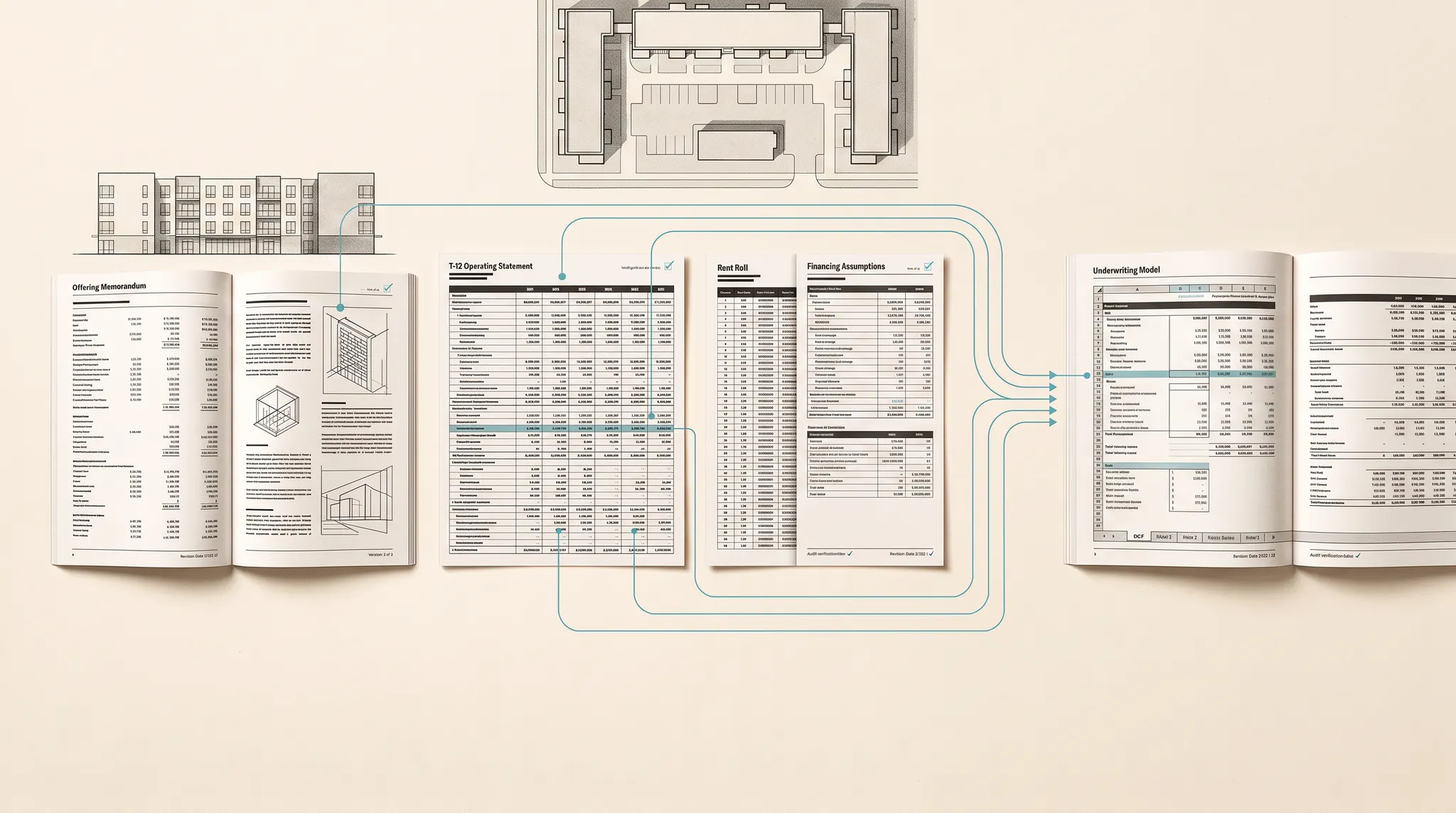
Noal can ingest an offering memorandum, T12, and rent roll in PDF or Excel format, including messy source documents. It then builds an underwriting model using those inputs, alongside market data and other sources. For off-market deals, users can instead enter an address and begin an underwrite without an existing deal package.
What ultimately stood out in our demo was the emphasis on showing users where numbers came from, and allowing them to correct the model when necessary.
Starting With the Source Documents
Noal’s team repeatedly returned to the idea of “good data in, good data out.”
When a user uploads an OM, rent roll, and T12, the platform extracts the underlying information and begins building the property-level analysis. It can identify unit mix, in-place rents, vacancy, income, expenses, and other financial information used in the underwrite.
Crucially, the platform does not assume every source document agrees.
During the demo, Noal showed how it can flag mismatches between an OM and T12. If it finds an expense or income line that it cannot confidently categorize, it can leave the amount unallocated and alert the user, rather than silently forcing it into the model. Users can also return to the source document behind an extracted number, and Noal said it is working on functionality that will highlight the exact area of the document where an extraction issue occurred.
As noted, everything remains editable. Rather than positioning the platform as a replacement for the person responsible for the deal, the Noal team explicitly described human verification as important throughout our demo - particularly because the extracted property information feeds subsequent calculations and comparable analysis.
The platform also records changes made during an underwrite. Users can see who changed an assumption, and add comments explaining why, creating an audit trail that is difficult to replicate when multiple analysts are passing around different versions of an Excel model.
Building the Underwrite Around the Firm
Noal is designed to adapt to the way an investment team already underwrites, rather than forcing every customer into the same model.
During onboarding, the company can take a firm’s existing Excel model and assumptions, and configure the platform around them. It can also use an existing investment committee deck as the basis for the final output.
Real estate firms often have their own assumptions, return requirements, and ways of presenting deals internally. Changing all of that simply to adopt new software creates another barrier to implementation. Noal instead wants users to move an existing process into the platform.
The company said one of its favorite pieces of customer feedback was, “It works the way we already work and the numbers are right.”
Noal also initially resisted adding Excel export, according to the team, because the platform was designed to provide stronger auditability than a spreadsheet. Customers kept asking for it, however, and Excel export has since been added.
Comps, Expenses, and Financing
Once a deal is ingested, Noal pulls comparable-property information through Hello Data.
Users can review the suggested comps, deselect properties they do not consider relevant, or manually add additional comparables. Hello Data scrapes its underlying information daily, according to the Noal team, allowing users to refresh a deal when newer comparables become available.
The platform also uses separate processes to help estimate taxes, insurance, and payroll.
For payroll, for example, Noal described looking at staffing requirements alongside salary information from sources including Indeed, ZipRecruiter, and Greenhouse. Its tax module goes deeper into county- and state-specific considerations, and can surface potential tax-planning issues for the user to investigate.
Noal also includes a built-in financing module. The demo showed agency, bank, and life company loan options side by side. According to the company, index rates are updated daily, while spread information is updated every two weeks.
That financing layer is particularly useful, because leverage can completely change the attractiveness of an acquisition. A deal that meets return requirements at 80% leverage may look very different if lenders will only provide 60%.
Users can then take those financing assumptions into the rest of the model, rather than sizing debt separately and manually transferring the results.
Finally, waterfall modeling is also built into the platform - with editable splits, acquisition fees, management fees, and other assumptions.
Does the Deal Actually Fit?
Noal goes beyond producing a financial model through its Deal Fit analysis.
During onboarding, a firm can describe its investment criteria - including deal size, markets, risk profile, capital structure, return targets, and value-add appetite. The platform then evaluates an opportunity against that buy box dimension by dimension.
It also produces recommendations designed to show what might improve the deal. In the demo, those included pushing in-place rents toward market levels, adding paid parking income, and examining potential property-tax strategies.
The team described this as a way of moving beyond “plug and chug” underwriting, and closer to the work an analyst would perform when deciding whether a deal deserves more attention.
Again, the recommendations should still be treated as inputs into an investment decision, rather than ‘instructions’ to be followed automatically. Noal repeatedly emphasized that the platform is intended to assist investment professionals, rather than fully replace their judgment.
Underwriting Can Continue Into Asset Management
If a property is acquired, the underwrite can subsequently be pushed into Noal’s portfolio section. Users can then compare actual performance against what they originally underwrote. Loan documents can also be uploaded, so the system can track information such as maturities and covenants.
There are limits to that functionality today.
During the demo, we asked whether Noal could evaluate a potential acquisition against the existing portfolio, and model how adding the new asset would affect portfolio-level returns. The answer was no, although the team said that capability is on the roadmap.
A chatbot is also not yet available.
Interestingly, Noal said users have requested conversational functionality so frequently that it has moved higher up the development roadmap. The team suggested one potential use would simply be navigating the platform, or asking questions about information already contained within an underwrite.
Who Is Noal Built For?
Noal is currently focused exclusively on multifamily. The company described its typical customer as a middle-market to sub-institutional multifamily owner or buyer, with enough deal flow to justify a dedicated underwriting platform.
Smaller groups reviewing only a handful of deals may struggle to justify the cost, while larger institutional firms often have established workflows, or are currently building their own technology.
Noal’s strategy is to go deep into multifamily, before eventually expanding into additional asset classes.
The company said it had signed up around 65 users at the time of our demo, after being commercially available for a little over a month. So far, customer acquisition has primarily come through outbound sales.
Pricing for Noal starts at $500 per month for 25 deals, rising to $1,000 for 50 and $2,000 for 100. The team also quoted a per-underwrite option of approximately $175. For customers on larger plans, Noal provides regular calls with an “underwriting architect”, who can help adapt the platform to the firm’s processes.
Where Noal Stands Out
Noal’s team identified Archer as its main competitor, and argued that its own advantage lies in data fidelity, multifamily specialization, loan options, and the ability to produce final reports and investment committee materials.
The team also said it has run side-by-side tests against Claude, and typically sees financial outputs from the general model that are around 5% to 10% less accurate - sizable errors, when it comes to real estate underwriting.
Obviously, we did not independently reproduce that test, so those figures should be treated as the company’s own assessment. The more useful takeaway from the demo was the product philosophy behind the comparison.
Uploading a T12 to Claude is easy. Building an underwriting process that knows what to do when the T12 contradicts the OM, shows where every figure came from, incorporates the firm’s own assumptions, sizes debt, records changes, and produces the required internal output, is a considerably larger task.
Noal is trying to package that process specifically for multifamily investors.
The platform is still young, and several potentially useful capabilities remain on the roadmap. For now, it is also deliberately limited to one asset class.
Regardless, the live demo showed a product already attempting to solve one of the biggest problems with AI underwriting today - giving investment teams enough visibility into the numbers to actually trust, review, and change them.
Enter your email to keep reading.
Get this story and every article on the site. Join 10,000+ professionals reading PLOT Daily. Free.